![Dye & Durham Logo.png]](https://solutions.dyedurham.ca/hs-fs/hubfs/DD%20Direct%20V2/Dye%20%26%20Durham%20Logo.png?height=40&name=Dye%20%26%20Durham%20Logo.png)
Control Accounts are general ledger accounts in your Chart of Accounts that are used to reconcile your general ledger with the subledgers for Clients/Matters (Accounts Receivable & Trust) and Vendors (Accounts Payable).
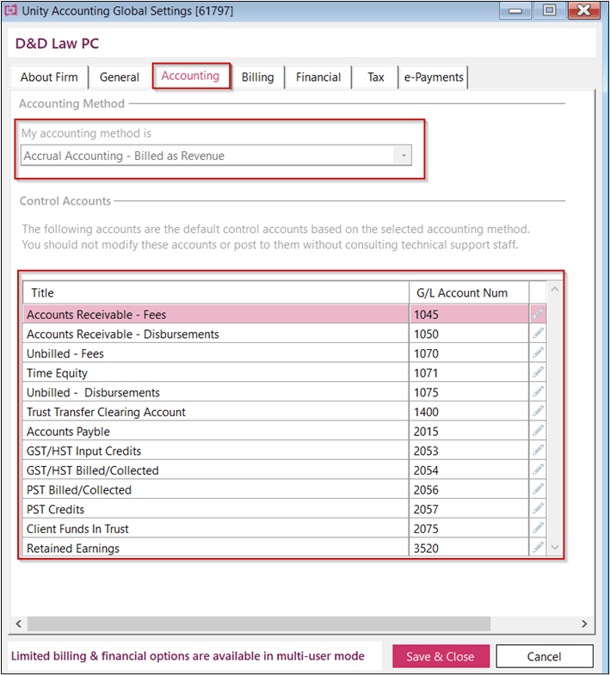
The above example is for “Accrual Accounting – Billed as Revenue”
The Control Accounts Unity Accounting requires, depends on the accounting method selected when creating a new company. Please refer to article “Unity Accounting Accounting Methods”.
Important:
- Accounting method cannot be changed after you begin entering transactions.
Verifying Client/Matter balances to General Ledger Control Accounts
For example, a trust bank account is a control account. When you enter a trust receipt, the software automatically updates both the “Client/Matter” and the Trust Bank general ledger account. The balance in the Trust Bank general ledger account must always agree with the total trust funds on the “Clients/matters”, for that bank account.
In example 2, the General Bank ledger account is not a control account. Funds paid out for company expenses unrelated to disbursements for “Clients/Matters” flow through the General Bank ledger account, and because they are unrelated to “Clients/Matters”, these are recorded as direct General Ledger expenses.
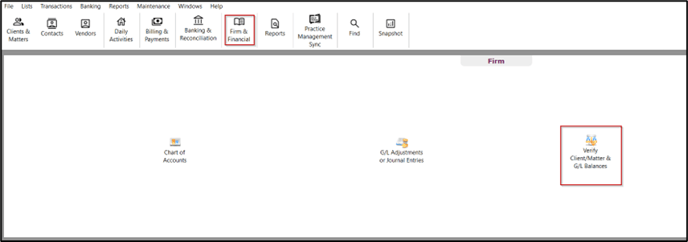
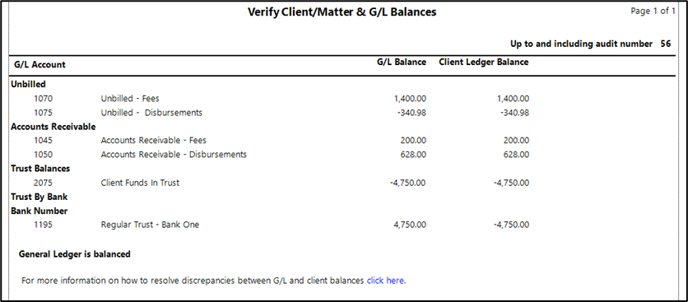
The “Verify Clients/Matters and G/L Balances” report, which is in “Firm & Financial – Verify Client/Matter & G/L Balances” displays the general ledger control accounts and the “Client/Matter” subledger balances. (See image below)
If the General Ledger balance and Client/Matter subledger balance for an account are out of balance, the report will indicate that your general ledger is out of balance including the amount. Refer to article “Verify Client/Matter and G/L Balances Report”.